
How it works
Neural character, playable control: four decoders, one blend, and a terrain drawn from what they actually produce.
Contour is powered by compact neural decoders trained on instruments from the NSynth dataset. The network supplies the evolving spectral character; a real-time harmonic-plus-noise engine turns that description into responsive audio.
Four neural decoders. Each corner holds a different learned instrument. The decoders respond to pitch and loudness 250 times per second.
Continuous interpolation. Your position becomes four blend weights. Harmonic energy, filtered noise, and amplitude move together without preset jumps.
Real-time resynthesis. A bank of 60 harmonics and 65 noise bands reconstructs the sound, then ADSR and spatial processing shape the result.
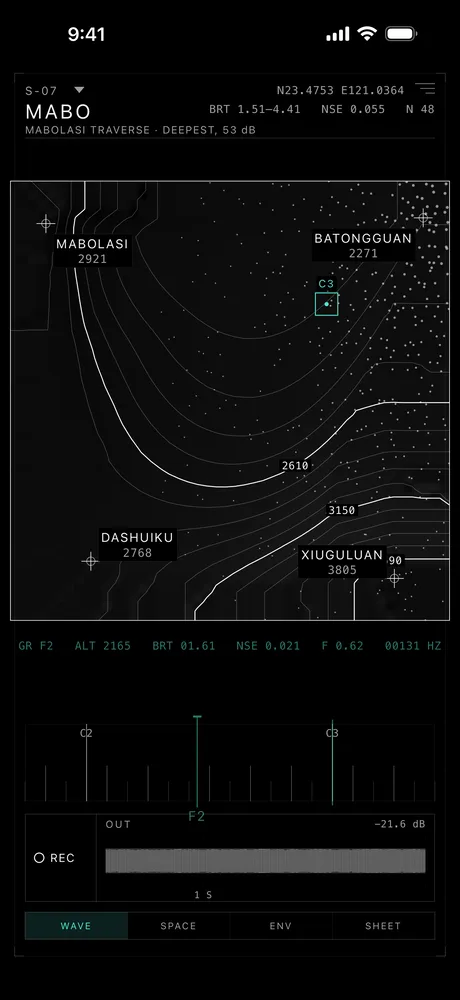
The contour lines are not decoration. Every line is generated from the sound the four decoders actually produce. Spectra are projected into a perceptual space, distances are measured, and the result is drawn as terrain. Cross a contour and the timbre has changed by a known amount.
- Brightness
- Spectral centre of gravity
- Noisiness
- Noise-to-tonal energy
- Distance
- Change between neighbouring spectra
- Elevation
- Brightness relabelled as topography
Corner instruments use decoders trained on the Google Magenta NSynth dataset (opens in a new tab), licensed under CC BY 4.0.
Some of those sources were recorded in a room, and the room comes with them. If a sheet sounds wet with SPACE at zero, that is why: see Why some sheets sound like a room.
Related
Still stuck? Write to zhi@nonoaudio.com. Support page